Friday, June 11, 2021

Part Two - The culture I turned my back on

My retirement from Amazon gave me insight into why people are reluctant to come forward when suffering harassment. The implication was that I was in the wrong. My complaint was ‘investigated’ and a decision was made in favor of those I complained about, not surprisingly someone higher up the corporate ladder; I became the one at fault, my retirement ‘gift’ was a metaphorical slap in the face. 

I interviewed with Amazon at the age of 67 - almost 68. In fact, I started work with them two days before my 68th birthday. Interviews are different in Amazon. Yes, there are coding questions; these can be completed in the language of your choice and the emphasis is not on how correct the code is but your thought process, how you deal with ambiguity and how you come up with a solution; all other questions are centered around behavior as it relates to the Amazon Leadership Principles (LP). Amazon only hires the very best of the best, or so they claim, and they keep raising the bar. It can be daunting to be surrounded by people who are geniuses and top performers, particularly in a technical world. It is very easy to question your own ability. I honestly did not expect to be offered a job, partly because of my age and partly because I suck at interviews. Almost a year later The New York Times published an article slamming Amazon's brutal culture. I flatly denied all it reported to anyone who asked me. That was then.

In the first 3 years I had 8 different managers, most of them temporary while they tried to find a permanent hire. The temporary managers were in name only and had no interest in managing the team nor in career development for the individual team members, they were already too busy with their own teams. Finally, a QA Manager was hired, he stayed for a full year, the longest any manager had been in place. When he left I put forward a case to make me manager. I had managed QA teams in two previous companies and didn't want to return to the of the lack of leadership we had before. After some discussion it was agreed that I would take over as a QA Lead and it was another 18 months before I was given the title of Manager. 

Fortunately I didn't need the title of Manager to have access to all of the managerial tools and processes and I was included in the various meetings and emails related to people management. That was an eye opener!  When it was agreed that I take over managing the team, there was also a reorganization taking place. Up to this point, the QA team was responsible for two separate development teams. The reorg split the team into two separate QA teams, one for each development team. On my team there were two QAEs, me and one other, and two Software Development Engineers in Test (SDETs). It was decided that the SDETs would report directly to the development manager and QAEs to the QA manager. Essentially that was me with one direct report, plus I had open requisitions to hire another two, one located in Seattle with the existing engineer and one to be located in Austin with me (our developers were also divided across these two locations), plus we had two junior engineers in Bangalore to support as needed, they did not report directly, but had a dotted line, to me. Of the two SDETs, one was in Seattle and one in Austin.

During the course of the exactly 4 years that I was officially managing the QA Team, that is as a QA Lead, then as a Senior QA Engineer and finally as a QA Manager, I hired 5 engineers, achieved 9 promotions, pivoted 1 engineer (unregretted attrition), coached two Engineers off the Development List (DevList)  - more about that shortly - and to be clear I was not responsible for putting them on that list in the first place, and had just one engineer leave (regretted attrition) and he left for the same reason I did (see previous blog).  I also assisted one QAE to make the almost impossible transition to developer. This is not intended to be a resume of my achievements, I list these here because I feel the need to put forward an argument as to why I believe I was under valued and badly treated by Amazon.

As I mentioned, I did coach two of my direct reports off the DevList. One had been put on the list by the departing manager I replaced. I took over in early February and the annual review is done during December and delivered in late February; when I took over all that was left to do was deliver the message to my new direct report. There is supposed to be a shroud of mystery over the DevList - that is no one outside of management is supposed to know such a thing exists, because that would allow them to be aware of the ever possible pivot path; in reality most people are aware of it to some extent; some managers will be transparent with their staff, and word spreads as people move teams; of course, you do tell them if they are under performing and you make them aware that they are being coached for this. For that reason, when I delivered the bad news that he would be getting no increase in compensation that year, I assumed it would be expected. He said he had not been informed that his performance was in question, nor had he been coached. I also believed that he should not have been placed on the DevList in the first place, while he had some gaps in his skill set I felt that these could be filled with mentoring and his other skills made him a very useful member of the team. He was the first person I coached off the DevList; he later achieved promotion. 

The second was one of the original SDETs. Both SDETs reporting to the development manager were given mind numbingly boring projects to work on, essentially nothing to do with QA work, more development tasks that were too boring for the Software Development Engineers (SDEs) to do. The SDET in Austin was the first to go, that is he was placed on the DevList and avoided pivot by electing to move into a QAE role, this also meant that he would then be reporting directly to me. I set about coaching him off the DevList, this was not a difficult task as he turned out to be a first class QAE. Meanwhile, I filled both of the requisitions, the one in Seattle was an internal transfer and the one in Austin was an outside hire. 

I have worked in a number of different companies, and I can tell you that achieving promotion in Amazon is more difficult than any process I have ever experienced in my life before, and not least because the process changes almost every quarter, so with each new candidate it is a whole new learning curve. It is not just hard for the candidate to qualify for that promotion; they have to be seen to be actually performing at that level before they will be considered. The manager has to put in a lot of hours coaching, identifying projects required to fill 'gaps' and prepare a document. If the document is not written in the accepted Amazonian way, the promotion is likely to be denied even if every other requirement is fulfilled. The candidate in turn has to spend a lot of time working on projects that are purely designed to demonstrate some skill set and serve no other purpose - that is a lot of engineering hours wasted to achieve a promotion that is obviously deserved by most standards. Finally there is the effort required to get feedback. This has to be from engineers of good standing and a higher level than the candidate. Naturally everyone is so busy in Amazon, it is hard to get people to commit precious time to supplying feedback, so more hours are put into follow up there, and if the feedback is not written in the accepted Amazonian way, that too could jeopardize the promotion approval. An added complication is the ever revolving door, with each new manager the promotion in progress has to be restarted.

As difficult as the promotion process is, the pivot process is ten times more difficult; it is more emotionally draining. The reports available online, such as the NY Times article are correct. Amazon has a pruning process. Indeed, they do 'hire and develop the best', but they are also always raising the bar (or moving the goalposts) and if the best don't keep improving they will sink to the bottom, though a better analogy is that the bottom will rise up to their level. However, the huge flaw in this logic is that they demand that each department (org) within Amazon prune a certain percentage of their staff; the exact percentage varies but is usually between 3% and 7%. If you happen to have a very high performing org, and another org has a majority of low performing, or staff that perform to a lower standard than yours, you still have to prune the percentage for that year - so you let some of your engineers go, while another org keeps engineers who are never going to be as good; essentially Amazon is losing high performers just to satisfy some stupid notion that doing so raises the bar; in practice it could well be lowering the bar. There is also the competition between groups within that org to try to keep their staff by denigrating the other managers' staff. The other inefficiency of this process is it incurs more unnecessary work recruiting, interviewing and onboarding new staff to replace those pivoted out; from start to finish the entire process is extremely stressful both for the employee and the manager. It is also disruptive for the team. Those are only a few of the things that frustrate me about this process. I do know of managers who deliberately hire in order to have a suitable pivot to avoid losing any of their existing staff.

There is also another side, less traumatic but also detrimental (in my opinion), to this method of leveling performance. That is the Top Tier (TT). Again only a certain percentage of staff in each org can be given this 'grade'; it carries with it a more substantial increase in compensation and stock grant. My objection to this is that as only the very few can reach this level, those who are equally deserving, but possibly not as well liked or as well known, within the hierarchy of the org's management, are left feeling under valued.

When one of my engineers in Austin transferred over to the development team, I replaced her with an internal transfer who turned out to be a serious mistake, though he did introduce me to the entire pivot process and a lot more I would happily have remained ignorant of. 

In order to pivot a candidate, they first have to be coached; this process was called putting them on the Development List - DevList, they are then given projects to challenge them to prove they can perform up to some standard and all of this takes more time, plus the required documentation is more busy time. As I said, I only had to go through this process once in my 4 years, and while that one engineer was most definitely not high performing and should have been gone long before he joined our team, this proved very difficult to achieve. He had already worked in three other orgs within Amazon before joining my group. And while I have got to admit that hiring him was a mistake on my part, I can be excused in part because as an existing Amazon employee we do not go through the same rigorous interview loop - the assumption is that this was done when he was first hired (an assumption I never made again). Secondly, he had been through the DevList process twice before with different orgs and knew way more than I did about it. Before digging deeply into his bag of tricks to avoid pivot, he suggested to me that I should take him off the DevList and he would look for another position within Amazon - leading me to believe that is how he managed to survive this long - an engineer on the DevList is immediately excluded from moving within Amazon. I was not going to do what the other managers had clearly done and take the easy way out. I was still prepared to fight for what was best for Amazon. What followed was 9 months of sheer torture for both me and the candidate as he played every legal card in his repertoire; I became friendly with our HR representative over the course of those 9 months as we tried to deal with this case. Due to a number of reasons I can't go into the details more than I have done, sufficient to say that he finally did leave Amazon. 

Other managers have had totally different but equally stressful cases to deal with. As bad as my experience was, at least my employee was definitely under performing and would never be able to do the job he was hired for; other managers have to go through the motions and still get rid of the employee no matter how they perform, just to make up that percentage; I have proved I have no objection to pruning dead wood, but by imposing a specific percentage each year we definitely lose good talent and add unnecessary workload to managers and the team. Believe me when I tell you, it is not the manager's choice. In almost every case they are forced into it by more senior managers or directors being pushed to make their quota. This process is often more stressful for the manager than it is for the employee, particularly as it repeats every year; while you don't always have to pivot one of your direct reports, you do always have to go to battle to save them.

Apart from that one under performing pivot, for the four years I managed the team, it was happy and high performing. The one remaining SDET in Seattle sadly was not so lucky and he was pivoted out the year before I left. He kindly gave me this quote on his situation:

"I came to believe that the only viable path to acceptance on my team was to transition from SDET to SDE.

As an SDET, when I used to report to a QA Manager, I had a future: I mentored, I presented at conferences, I made meaningful design choices, and spread influence and code across teams. When I started reporting to the Development Manager, not only did these opportunities seem to dry up, but I began to notice that I was being hailed louder and more persistently by a narrative I had heard in the background for my, then, entire 5+ year tenure at Amazon: SDEs are first class engineers, QAEs and SDETs are second class engineers. I set out to prove myself worthy of my job, ironically, by attempting to transition from SDET to SDE (a role I've never had the temperament for). After a year of teething, dealing with my dad's death, and being withered by the aspersions of a toxic senior SDE, I was offered a pivot plan, and opted to take a golden parachute instead."

While I was not pivoted, my departure was nonetheless unwelcome. I felt I had no choice but to retire, and unlike the pivot, I left without a payoff; perhaps I should have forced the pivot but I didn't have the stomach for that - not only would it have been dishonest, I don't think I could have tolerated the treatment for that length of time and above all, my team would have suffered. 

Amazon demands loyalty from its staff but does not repay this as I discovered. If you missed my earlier blog entry on the events leading up to my retirement, it is here.

To read more from the many Amazonians, past and present see here. 

The Business Insider has a lot more to say about this.


Friday, June 4, 2021

Part One - Why I chose to retire from Amazon

The age at which workers retire has changed greatly over the last twenty years.  Manual workers are expected to retire as their physical strength and energy ebbs. Those who use mental energy and strength acquire a greater value to their profession with the experience and judgement of their years. Typically judges, consultants and leaders of industry continue working until they feel they have no more to offer.

Many people look forward to retirement. The gold watch and gratitude for their service; the leaving party when the retiree is lauded for their achievements. Overall, a happy event.

My retirement was a vastly different story.  While I received many heart warming emails from colleagues and my direct reports held a virtual 'party' to bid me farewell. Leadership ignored my departure. I worked for Amazon as a Quality Assurance Manager. I had developed a well-knit team who performed to the high standards required by Amazon. Together we had chalked up many innovations and successes. No one had ever complained about our productivity. On the contrary we received many accolades.

In late November 2020 my then manager told me he was moving to another team. He then told me that the plan would be for me to report to one of the Software Development Managers (SDM) in our group (let's call her Anna). I told him that if that were to happen I would leave. He already knew that there had been problems between Anna and my team  He said it had not been his choice but he would get back to me.

The following day the other senior manager (we will refer to her as Kate) in the org set up a meeting with me; she would be taking over from my manager and I got the impression that she made the decision that I would report to Anna, who in turn would be reporting to her; I was the only one of four managers on the team not reporting directly to Kate, despite the fact that all of the managers in the group were at the same corporate level and I had been with Amazon longer than any of the other managers. Kate's direct reports would be reporting up to the director (we will call him John) during her upcoming absence. I suggested that I could report to Gerry (not his real name), an SDM who is based locally and is on the same team, while Anna is in Seattle WA. But more important to me was the fact that Gerry had experience managing QA teams and was a reasonable person. I felt that this was a logical solution for everyone. Kate said she would talk to John and get back to me. 

Without any consultation with me or indeed with my team, we were being presented with a new manager. That in itself would not be a problem, but the person chosen, Anna, had only recently moved into a management role with little knowledge or understanding of the area in which we worked. Although she was relatively new to people management, my team and I had clashed with her in her previous role as a project manager and knew her to be a micro manager with a combative approach. Her lack of experience appears to make her aggressive in her approach and she tends to treat those reporting to her as beneath her and attempts to impose her will by shouting down any effort to discuss and ‘pulling rank’. I knew this would be a mistake as we had an integrated happy team and this boded nothing but disaster for the continued success of the group. Naturally I approached leadership to make them aware of the issues. I found myself stonewalled and it appeared that this was a reorganization made with an agenda which was not clear and was obviously not going to be shared with me.

When Anna started managing QA the level of bullying was even worse than I had imagined. I was harassed at every turn, my methods were criticized, my management of my team was undermined by her. She wanted me to implement processes that were archaic. When I explained that these had been tried and discarded as not of value, she went to one of my direct reports and instructed him to put the process in place. 

Due to the pandemic, we were all working from home and, to help team morale, we were allowed a budget to have monthly virtual social gatherings, it was also made very clear that attendance was optional. QA Engineers are generally speaking, introverted and we had all agreed we really didn’t want to get involved in these. She told me that I had to hold monthly social gatherings for my team, when I told her that we didn’t have any interest in doing so, she insisted and said it was mandatory, she then went to one of my direct reports and insisted that he implement these. These are just a few examples, there were many more.

I believe that bullying in any situation, school, work or home should be called out and not allowed to continue. I went through the few channels available to me to attempt to solve the problem. As I saw it, having me report to another manager in the same department should not have been that difficult, the solution was obvious; change the reporting line to a manager located in the same time zone and who had relevant experience. I don't blame Amazon entirely for this poor human relations and management decision. Amazon is a huge company and while they have some very laudable leadership principles to which they pay homage and claim to hold every 'Amazonian' responsible for upholding, in reality many of the executives have their own interpretation of these principles, and when it comes down to it, they do pretty much what they want with very little repercussion, as I discovered.

During a 1:1 with Anna she told me that I was mismanaging my team and she would have to study what I was doing wrong and correct it. This went against all management principles reducing the operation of the team to that of a school yard battle. I emailed HR and said that I was not at all happy with the restructuring. This is what I sent to HR:

Over the past year the relationship between the development team in Seattle and QA has deteriorated, in part because of [Anna's] attitude to the QA group. In particular I have had both [Anna] and my direct reports coming to me complaining about the other. The QA team has lost trust in [Anna] and I believe that she not only does not understand the QA function, she does not respect our group. On more than one occasion I brought this up to [my manager], so he was aware and I was surprised at the decision considering this.

Some examples:

  • She has accused my QAEs of not reporting status and or blockers, when they have reported them she has just not read their emails, or has missed attending meetings.
  • She has set launch dates for projects without getting QA input into how long we would need to test, taking into account resources and other commitments and then pushed for QA to meet these dates
  • As a result of these unreasonable deadlines, the entire QA group has been working close to 60 hours per week for a number of months
  • She has invited my direct reports to meetings without including me and tried to bully them into agreeing to bypass QA processes to achieve her goals
  • At [my departing manager's] staff meetings I have tried to discuss issues between development and QA and how to best fix these, she has blamed QAEs by name where the only issue is a broken process and she has not been prepared to work with me to fix that process
  • At monthly talent discussions [Anna] has claimed that none of her developers are below the bar and instead tried to down level QAEs. Currently I do not have any direct reports who are not raising the bar.  
  • I would hate to lose any of my QAEs but with [Anna] as their skip level I fear that will happen as they have shared with me that they cannot work for her, and I fear that she will LE* them in order to protect her developers.
  • Despite expressing my concerns to both [my departing manager] and [his replacement], who spoke with [director] about it, he is not prepared to reconsider and has not even reached out to me to discuss this.  

As a result, I am now looking for other opportunities within Amazon and want to be sure that you are aware of my concerns, and those of my group, going forward.

*LE: Least Effective and next step is being managed out

The  next day the director John, set up a meeting with me. He appeared to be very concerned and claimed to be unaware of the situation; he assured me that nothing was carved in stone and suggested that I give it a month and come back to him after which time, if I was still not happy with the situation, he would rethink it. He also said something that I found curious; he said that he believed that the friction between Anna and my team could be resolved by putting her in charge, he felt that she would be obliged to be ‘nicer’ to us if she was managing us.

The only way I managed to get through that month was because it was December and we had a few days off over Christmas and the New Year. The rest of the time Anna not only harassed me, setting up meetings two or three times a week, but she also had meetings with my direct reports assigning tasks to them and basically taking over the management of the QA team and attempting to undermine me.

Once that month was over I requested another meeting with John. I was confident that he would keep his word and deal with this unbearable situation. To my surprise he said no, things would remain as they are and I would just have to make the best of it. That was totally unexpected, and left me reeling. I was very stressed out by the constant bullying sessions with Anna and already one of my engineers had given notice. I was very happy for him because he was one of the people that Anna had taken a dislike to and I knew his job would not be safe with her in control.

The decision had been made with little or no regard for how it would impact me or my team. This clearly had been decided further up the management chain and was beginning to show the signs of favors done and people being placed for other than business reasons  It is clear  that my departing manager did indicate that it might not work, because he already knew that there was friction between my team and the inexperienced incoming manager, I began to think that I was being forced out. I had a hard time believing that at first, because I had never had any performance issues plus my team was very high performing, as I mentioned. Whilst John was not an effective leader he was personable if hierarchical. He tended to have little respect for those who were not on the management team. I made it very clear to him how unhappy I was, and I gave him examples of the bullying tactics being employed to try to force me to put in place processes that absolutely went against all of the QA principles I had ever learnt in my almost 30 years working in QA, he still refused to consider any change to the arrangement and even went so far as to claim that her behavior was perfectly acceptable.

After a few days looking at all my options I finally emailed HR again; this time I said that I believed I was being managed out and as I had never had any performance problems I could only imagine this was a case of age discrimination. I wasn't ready for the reaction - apparently 'age discrimination' is a big weapon but I had no intention of using it as such. Unfortunately, due to our 9 months of close association working on another HR issue not related to this discussion, our HR representative had to stay out of the situation, while I fully understood her position, it was disappointing because I had great faith in her ability to deal with the problem. I was assigned another HR partner and after a few meetings with her while the situation with Anna deteriorated rapidly, I finally emailed HR and copied my director saying that as the situation was becoming intolerable and they were unwilling to fix it, I was considering retiring and when I made my final decision I would give them official notice. I also told my team the same thing, I had talked about retiring perhaps in about two years, and had started grooming my senior engineer to be ready to take over managing the team but I wanted to let them know that this might be sooner than expected. To be clear, I did check with HR first to see if I could be fired for sending out an early warning of my intention to retire sometime in the coming months; possibly May. I was told absolutely not.

The reaction to this email confirmed in my mind that they were deliberately trying to get rid of me. The first thing that happened was yet another meeting with Anna, where she made a big fuss about the fact that I had not told her I was retiring. I told her that I had no definite plans and once I decided I would let her know. She said that my senior engineer had told her, which was unfortunate, but I had not told the team it was confidential and so could really not fault him. The next thing that happened was John set up a meeting with me. I was so relieved, thinking that finally he was going to make this horrible situation right. Not true, he was clearly annoyed and said that Anna had complained to him that I had not told her I was planning to retire. I pointed out to him that as I had stated in the email I had made no firm decision and would of course tell her when I decided. That was not good enough for him. He suggested that as I was planning to retire, I should go ahead and step down from managing the team; my senior engineer would take over the management and report directly to Anna and I would in turn report to my engineer and of course I could retain the title of manager. This 'solution' sounded very strange to me, because at that point I had not officially resigned nor set a definite date for retirement but here I was being shoveled out the door, while I was not being fired, I was definitely on the exit ramp now. I told John that I would talk to my senior engineer and see if this arrangement would work for him.

The following week I met up with John a final time and told him that my engineer was prepared to take on the management of the team and that I would report to him. I said it was very clear to me that he was trying to manage me out and I could only assume this was age discrimination. At that point, he clearly got very angry, bear in mind all of these meetings were virtual, due to the fact that I was in Texas and all of these people were in Washington State, but on my screen I saw him straighten up suddenly and the anger was clearly displayed on his pudgy face, he said in a loud voice "I will have to report to HR that you said that ... !" almost immediately he slumped back into his usual toad like position and said "... and that is not a threat" I was confused by that last statement because I didn't see it as a threat, unless he was referring to his sudden anger. I responded "I have already told HR".

This was the point where I gave up and decided that I would definitely retire and settled for the end of May as this was clearly what HR and leadership wanted and the situation with Anna was growing more intolerable. This would give me plenty of time to train my senior engineer and offload my own tasks, plus give the team time to adjust to the idea. I advised HR who requested that I write an email advising the org of my decision to retire, explain the weird reporting structure and they would review and approve the email before I sent it out. This I did, being as politically correct as I could manage. But still it was edited before I was approved to send it. This was the final version:

Hi All

 As some of you know, I have been thinking about retirement for some time now. Now has finally arrived and the fish are calling. [Senior Engineer] has agreed to take over the management of the QA Team, and I have agreed to remain until end May in order to ensure a smooth transition for him and for the team. So that [Senior Engineer]  may get exposed to all aspects of management while I am still here to help,  [Senior Engineer] will move into the role and report directly to [Anna]. [Senior Engineer]  and I will work on transitioning all of my tasks, and bringing him up to speed on being a  people manager at Amazon, I will report to [Senior Engineer] .

 On 31st May I will hang a sign on my virtual door “gone fishing”. Before I get out the rod and reel I will of course, send my farewell email with personal contact information should anyone want photos of the amazing bass that are currently waiting just feet away from my doorstep, in Lake Travis.

A week after the last meeting with John I was contacted by Employee Relations. Up to this point I actually believed that the Employee Relations Group existed for all employees and I was surprised that it took them so long to get involved. Turns out I was wrong, they are there for the leadership, upper management protection. My statement to John, and his report to HR. had stirred up Employee Relations and they were now interrogating me in order to protect John and not to put right any wrong done to me. I told the very nice guy of all the instances of bullying I had experienced, and that I had reported these to the director and to HR, and that John had originally promised to reconsider the situation but then reneged. He listened carefully, asked a lot of questions and at the end of an hour I felt grilled and exhausted.

For weeks I heard nothing more from HR nor from Employee Relations and I went ahead with my plan to retire. During those weeks I was contacted by a number of people in Amazon who had seen the change in the reporting structure for the QA team and were confused by a QA Manager reporting to a QA Engineer; their sympathy and support helped me to deal with what was a very stressful situation. I started preparing in earnest for my retirement. I have to admit it was a scary prospect. I had almost no understanding of Medicare, and I worried that our medical cover would either be inadequate or horrifically expensive. That was just one of the small items I worried about. So I did what I always do in times of stress, I googled, read and wrote. In writing I have always found relief, it is very therapeutic. I prepared my resignation email and my farewell email, and as the time grew closer, I read and reread these.

Then, just four weeks before I was due to retire I got an email from the Employee Relations guy working on behalf of the director. He set up a meeting with me for 4.30 that afternoon, late for me considering I start work at 4.30 a.m. but I wanted it over with. I was not in the least bit surprised when he told me that he had talked to the director and he had established that there had been no bullying and no age discrimination. In my mind's eye I saw him say to the director "did you treat her so badly because she is old?" and the director say "no!" and he said, "oh, ok then".  I mean, what else would he do? he had already told me he was working on behalf of the director, to be exact he told me that Employee Relations got involved because a Level 8 director was implicated - I was Level 6 therefore not so important.

I still question what was going on. I had observed that Anna suffered from low self esteem and my experience has been that many people find the only way to combat this is to try to bring those they see as competitors down. I guess that if she could 'manage' me into underperforming she would be happy but as I was not prepared to cooperate with this, she was able to manipulate John to give me no quarter. How she managed to have such influence is definitely outside the realm of this narrative - but I have to admit I am curious.

On May 14th I sent my resignation email to my 'manager' that is my senior engineer to whom I was now reporting, and I copied HR:

To whom it may concern

I wish to officially submit my notice of resignation effective 31st May. As the 31st is Memorial Day, my last day will be May 28th. 

I have worked at Amazon for almost 7 years and for nearly all of that time my experience has been a positive one in terms of work, professional development and interaction with colleagues.  Sadly my recent experience of bullying, harassment and undermining of my professional confidence has left me so wary of the company and organization that I regretfully turned down an offer from another team to manage their QA team. As [HR] was unable, or unwilling, to address the situation in which I had been placed, I believe I have no option but to leave Amazon.

I would like to thank [HR partner] for her continued support over the last few years. Most of all, I would like to express my gratitude to [senior engineer] for being prepared to step up and take over the management of the QA team and I wish him and the team every success. 

I received two separate responses to this email, one from HR the main message was "Thank you for the update. When you shared your concerns, we conducted a prompt and thorough investigation. ... The result of those investigations was that your concerns were not substantiated ...".  A slap in the face but no surprise there. The second was from the Employee Resource Center (ERC) (very different from the Employee Relations previously mentioned) giving a long list of actions required prior to my departure in order to clean up after myself; all pretty standard stuff, it included this bullet point:

"Complete the [internal application] Exit Interview questionnaire, which is available within seven days of your termination date. Your feedback is very valuable and can only be seen within HR, unless you indicate otherwise."

As I waited for that last week to end, I thought about what I was heading into, and what I was leaving behind. With three days left to departure I had still not received access to the questionnaire mentioned. I emailed the ERC to let them know and got a response to the effect that they would follow up. On my second last day I again requested an exit interview, again the response was unrelated to my request and I had to conclude that Amazon did not want my feedback recorded. Here is why an exit interview is considered important by the HR community. 

"Exit interviews are important because they offer a deeper look at your workplace culture, day-to-day processes, management solutions, and employee morale" - HRAcuity

Finally my last day arrived and it became apparent that I was being denied that final exit interview, perhaps they just didn't care to have a record of my side of things. On balance, the unknown next chapter of my life was way more appealing than that which was about to come to a close. I worried about leaving my high performing team to suffer at the hands of a manager who clearly did not understand the Leadership Principles, in particular “Earn Trust” which is described by Amazon as “Leaders listen attentively, speak candidly, and treat others respectfully. They are vocally self-critical, even when doing so is awkward or embarrassing. Leaders do not believe their or their team’s body odor smells of perfume. They benchmark themselves and their teams against the best.” Anna neither listens attentively nor is she vocally self-critical. Once she had responsibility for the QA Team, contrary to what John suggested, she did not start to treat us better, she became more authoritarian and disparaging. However, knowing what I know about this and other aspects of Amazon’s culture, I am glad to be turning my back on it. This is the end of a chapter, it is not the end of the whole story.

"You own everything that happened to you. Tell your stories. If people wanted you to write warmly about them, they should've behaved better". - Anne Lamott


Saturday, May 29, 2021

Retirement Day

On my last day of work I still had not received the promised email with a link to my Exit Interview, which like everything else in Amazon is self service - that is an online questionnaire. I checked my email and the web page where the link is expected to materialize for the exiting employee. Nothing.

Actually, my official retirement day was not for another two days. 31st May. However, as that was Memorial Day and a holiday, my last day would be Friday 28th. I started the day at my normal time, 4.30 a.m. Central Time and chatted with a few of my colleagues in Bangalore - they are the reason I start so early; I like being able to interact with them in real time rather than by email. Next I cleaned up my work email and laptop hard drive. I know that when I return the laptop it will be reimaged immediately, but I still feel obliged to clean up after myself.

I again checked email for the Exit Interview; nothing.

For some weeks I had been avoiding attending meetings involving the wider team - that is development and product; I restricted my interactions to just the QA team and only some of these meetings as I sought to reduce any dependency on me and avoid unintentionally tripping up my senior engineer who was taking over the management of the QA team. On this final day I joined the Austin development team's standup in order to say a thank you and farewell, unfortunately there were only two of the 5 member team present but they bid me a fond farewell and wished me luck.

Checked email for the Exit Interview; nothing.

Next I sent my farewell email to the wider audience, the Product team in Seattle, the Development Team in Seattle - most of whom I had never met as they had been hired on during the lockdown and to all of the people I had worked with in the almost 7 years at Amazon; the friends I had made along the way and of course the Development Team in Austin who I had worked closely with, and my own QA Team.

I checked my email for the Exit Interview; still nothing - the original email suggested that Amazon would really appreciate me filling in this questionnaire as it would assist them in constantly improving their employee relations. As they already knew that mine was not a happy story, apparently they didn't want to hear it, or perhaps didn't want it on record.

At midday I dialed into my final meeting of my working life. No, not a wider team retirement meeting, not a final meeting with the group leadership to wish me well - that didn't happen; it was better than that. The QA Team I had been part of for almost 7 years, and had managed for 4 of those years had scheduled a farewell meeting. In attendance was all three from Bangalore - bear in mind this was the end of a very busy week for all of the team, and in India, very late on a Friday night; two from Seattle and two from Austin, plus the Technical Program Manager with whom I was friendly and the entire team worked closely with.

Everyone in the group turned on their video - a huge compliment as it is extremely rare for some people to ever do that. For the next 90 minutes my team took turns to give examples of how I had positively impacted their lives. One of the team had worked into the early hours of the morning to prepare a collage for me - we are friends on Facebook and she was able to gather photos of the many group lunches I had arranged over the years - both with the teams in Austin and on my many visits to Seattle. These were not just the QA team, but development and product teams also. I plan to have it printed and framed - that was my retirement gift from my wonderful team. My retirement gift from Amazon, and the leadership of the group with whom I had worked for 7 years was total silence.

Finally I called an end to the meeting as my colleagues from India were approaching their midnight and I was feeling somewhat overwhelmed by the gratitude and kindness shown by my team.

I checked my email again to see if I had received the Exit Interview .. nothing. So I emailed HR to make it clear that I had not refused to complete the form, I had never received it. Then I unplugged my laptop to allow the battery to drain in advance of returning it to Amazon.

Next morning, Saturday, I logged into my laptop again to check on the battery - still at 64% - so I decided to check my email one last time in case the Exit Interview had arrived the previous evening. I could not connect to VPN - my credentials no longer worked. Despite Monday being my official last day - as it is a holiday I guess they decided to shut me down on Friday. Luckily I had returned everything else to the office earlier in the month because no doubt my access there was also shut down.

Here is the collage my team gave me - in the top right hand corner is a screenshot of our final farewell meeting. My heartfelt thanks to that team of amazing engineers who went a very long way to making my retirement feel special. 


Now I just have to work at trying to relax and deal with the feeling of  being set adrift. I realized that I had become addicted to constantly checking my work email and chat client no matter the time or day. I find myself picking up my phone and realizing, that life is over and is going on fine without me. 


Saturday, May 8, 2021

It is the little things that matter

Some time ago I blogged about the impact of lack of appreciation. I was at a point in my life where I had been putting myself out for someone who took everything I did for granted. As is my usual method of dealing with life and it's problems, I wrote about it, naturally writing leads to researching and that in turn leads to a better understanding and so the therapeutic effect takes place. 

"Silent gratitude isn't very much to anyone." - Gertrude Stein

In the last week I had two instances of the complete opposite and experienced the huge positive impact that being appreciated has. The first was on Thursday. 

On the first Thursday of every month our cleaning service take over our home. We make a point of getting out of the house and giving them free rein. (Yes that is the correct spelling see here if you don't believe me). Up to this year I was at work and my husband would take his mother out to do whatever shopping she needed. Just before the Covid-19 pandemic took over his mother moved out of our home into assisted living and I was working from home full time; at that point I took a couple of hours off in the morning and we did our grocery shopping. This Thursday was no different. When we returned the cleaners had finished and were gone. On the counter in the kitchen there was a beautiful gift basket. I was dumbfounded and immediately took it apart to find who it was from. The only card in the basket was from the company who supplied it, Basket Case Austin, so I emailed them and asked them to tell me who I should thank. I got a response almost immediately saying they had emailed the sender. At the same time my husband received a text from our cleaning service, a family run business local to us in Lago Visa, Flores Cleaning Company, telling us that they had left the gift basket to thank us for being such good customers! All we did was pay them the very reasonable charge for a truly terrific job, and we never complained because there was never a reason to complain. I was so very touched by this expression of appreciation.

"Feeling gratitude and not expressing it is like wrapping a present and not giving it." - William Arthur Ward

The following day I had taken the day off work and we were out on the lake fishing when I received a text message from a guy who had worked for me for a number of years and had left my team just a few months previously. He wanted to know when he could call me as he had some news he wanted to share. I said "now is good" and he called. He told me that he had been offered a job with one of the top Tech companies in the world and he followed up by saying he would not have been able to get through the interview if it were not for the coaching and mentoring he had received from me while I was his manager. I was thrilled for him of course, and quite overcome that he credited me with so much, but most of all, that he took the time to call me and thank me. 

How often do we think, "thank goodness for so-and-so" and never think to say it to them? This man credited me with his great achievement and took the time to tell me so. Not only did I get a surge of Dopamine, but I felt vindicated. I was going through a difficult time at work, as a result of which I was getting ready to retire, and this one phone call went a very long way towards making me feel a whole lot more valued. 

“The deepest principle of human nature is a craving to be appreciated." - William James (Psychologist)


Monday, May 3, 2021

As promised

In a previous blog, I promised to let you know what I thought of the book I bought "How to Retire Happy, Wild and Free"; I had high hopes that it would be the definitive guide to a wonderful retirement. I was disappointed as I started to read it. 

The first major issue I had was that it touted the benefits of retiring early; this advice was way too late for me! 

Available here

"Put another way, if you put it off too long, upon your retirement you may find out that the best time to pursue our dreams and enjoy life to the fullest was twenty years ago"

And this one gave me pause:

"Even fishing all day on a favorite lake can get boring after a week or two.

considering that is part of my plan, not to fish every day, but every weekday that the weather is good.


But, ever the optimist, I kept reading. As I read on I found a few slightly more useful references and some examples of people who retired with minimal savings and still enjoyed their retirement. I have to admit the frequent references to the woman at home being unhappy to have her husband under foot all day, did irritate me. Given that I am eight years older than my husband and he retired a number of years ago, albeit early in order to care for his ailing mother who lived with us (see previous blog), he is the one who is now going to have to put up with me suddenly being there all day - and he will have to put up with me disturbing his restful day as I keep finding things for us to do.


Another recommendation he made gave me serious pause for thought:

"Don't forget to include your spouse in your retirement plan"

What? Surely no one secretly makes plan to retire and deliberately excludes their spouse?? When I read that pearl of wisdom to my husband he said "I hope you didn't pay for that book"? I am having a hard time trying to understand why anyone would not discuss retirement with their spouse.


So now I am wondering if this is a very old book and written back in the day when women didn't work outside the home and marriages were not partnerships. A quick search showed it was first published in 2004, definitely not 'back in the day' so I checked to find out what age the author is, apparently Ernie Zelinski was born in 1949; that makes him three years younger than me and old enough to know better! But, if he felt it necessary to give that warning, perhaps he knows of people who have done exactly this. My feeling is, if you would even dream of planning for retirement without discussing it with your spouse, your relationship is already doomed and so too is any chance of a satisfactory and enjoyable retirement.

I continued to read in the hopes that I would get some information of value from this book but I was losing hope. Finally, after completing only 25% of the book I did give up on it. It was when the author started pontificating about 'getting in touch with the inner you' and 'finding a greater purpose' that I abandoned all hope. It is not that I don't believe these are good things to do, it is that I object to his assumption that most people who are still working have not already done this. I know I have, and if you have read my book I think you will agree.

This blog is well worth a read
However, this book (or the 25% I read) did convince me of one thing; I am overthinking this entire process. This is just another adventure and I have taken far greater risks than this before in my life

I am retiring, I have little or no choice at this stage at least where my current employer is concerned, but I do trust that the universe knows best and I will go with the flow. If it doesn't work out I will make changes until I find the answer. That much I have most definitely done before, more than once; I have already proved to myself  'nothing ventured, nothing gained'. And also, nothing is impossible!

Currently my plan for the immediate future is: a midweek trip to Vegas in September, to celebrate our birthdays and my retirement (we are both fully vaccinated); a Masterclass membership - this is a one year access to any course, specifically I am interested in the writing course but will investigate all the courses they have to offer. Reading all the books I have stacked up, and not just while I am on the treadmill; continue my 4 miles a day on the treadmill in the early morning, but also drag my sedentary husband out to walk outside (he has already agreed) as often as possible; fishing trips on the boat during the week when the weather is good, or off the dock where it is not ideal for the boat; writing, I have abandoned this blog for too long and it is great writing practice - plus I have a book waiting to be written. Create new embroidery patterns and bring them to life; Cook and bake and perhaps another cookery book?? And once this pandemic is finally under control in Europe and the US, get to visit my family again.

As I get settled into the next chapter in my life, I will report back to you on how it is proceeding.


Friday, April 30, 2021

Fitbit

A few months ago I responded to a request to take part in market research for a Fitbit - I tend to do a lot of beta testing because quality assurance is not just my job, it is my passion; and while market research is slightly different the big temptation with this particular program was the fact that I got a free Fitbit, yes, I get to keep it, bonus because I would never buy one again.

When the Fitbit first hit the market both my husband and I got one. After a few months we gave up on them, actually they gave up on us and the company who then owned them refused to even respond to our call for help, that is we contacted their customer support and basically they said they could do nothing for us. As a result I was dubious but hoping that over the years they had improved.  It looked exactly the same as the one I had years ago with the exception of the buckle on the strap, but it definitely had a lot more functionality plus the phone app which makes it much easier to set up and interact with.

At first I was really pleased with it. The phone app made it possible to easily view my stats and I have got to admit that I really liked the report on my quality of sleep each night.  Of course I did realize that it was a little bit silly to be so delighted when the app agreed with me that I had woken multiple times during the night - very normal for any post menopausal female. I did wonder why my 4 miles on the treadmill each morning was not registered, yet all other steps taken were, it did measure my heart rate while on the treadmill, just not the steps. I was able to register the time and distance in the app, and then it calculated the number of steps I had taken during my exercise, not exactly high tech I think? The battery was good and only needed to be recharged once a week, fully charging within a couple of hours. I even enjoyed the resulting celebratory vibration when I achieved greater than ten thousand steps. For five weeks I enjoyed the feeling of satisfaction as my Fitbit cheered my achievements, more than ten thousand steps per day, 5 days a week and while it constantly encouraged me to consider going for the premium package I resisted. So glad that I did!

At the end of the 5 weeks, after a particularly bad night with almost no sleep, I consulted the app to get some consolation and discovered that my night must have totally confused it because it reported it as three separate nights  As the market research program lasted only two weeks, at this stage I was on my own.

These are the stages it reports

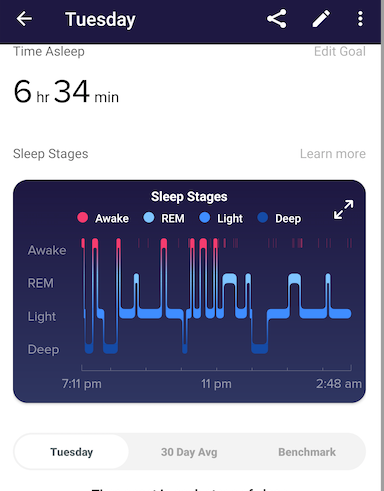
The image below is a screen shot of my Sunday night report. First of all, the bottom graph is way off. On Sunday night I actually went to bed at 7.20, as the middle graph reports that I fell asleep at 7.22 p.m.  According to the app, it needs more than three hours sleep to reliably report the stages, therefore the middle graph is what it terms 'basic' sleep pattern and so is the top. My assumption was that because I was awake so much during the night, it assumed two separate nights of less than 3 hours sleep and so reported the two upper graphs as basic sleep; I have no idea where it got the bottom graph from and my suspicion was it was secretly tracking my husband though he sleeps in later than 4.48 a.m.! or it pulled it from the previous week as some sort of consolation. And, just in case you are wondering why on earth I get up at 2.13 a.m. Well, there are a number of reasons, after a night of constantly waking it is almost a relief to get up at that hour. I have never set an alarm because I always wake early, I usually get up between 2.15 and 3.15 so that I can workout for an hour, and still be at my desk for 4.30 a.m. my normal start time. You see, part of my team is located in India and I like to be able to overlap with their normal working day so 4.30 works for that. That early rising time also explains the unusually early bed time.

This was what it thought of Sunday night

However, the following night, actually Monday night, it recorded nothing. The app suggested I wear my Fitbit to bed in order to record my sleep patterns. I googled "why did my Fitbit fail to record my sleep" and found this link, a Fitbit Community all experiencing the same issue. Turns out I was lucky to get five full weeks before it gave up on me. Many of the people reported that a reboot of the device fixed the issue. I tried that suggestion and sure enough, on Tuesday night it recorded my sleep again.


Something else I discovered in my google search was that the sleep tracking starts when the wearable no longer detects movement. What that suggests to me is it assumes movement during sleep represents waking? Now, I know that I am a very restless sleeper; I have restless leg syndrome, I have had it for so long that it only wakes me when it is really bad, the rest of the time I actually remain asleep and thrash around a bit to relieve it. If this is how the device figures out waking periods, then perhaps I don't wake up as often as it thinks. This suspicion led me to google again, where I found an interesting page of Fitbit help subjects and according to that, the device uses movement and heart rate to make an educated guess as to what stage of sleep I am in. 

The following night, Wednesday, once again no report at all. I rebooted the device and having read through the help page, discovered that it might fail to record sleep if it is too loose or in a position where it can't track heart rate. Given that it tracked without missing a night for five weeks, and so many other people reported the same issue as I was having, I find it hard to believe that is why my Fitbit is no longer interested in my sleep patterns, but I decided to try one more time. Thursday night I made sure the device was snugly fitted and the requisite distance from my wrist. Next morning I was actually surprised to discover that I got another valid report of my night's sleep:


The jury is still out but for the moment I will continue to wear my Fitbit although I am not really clear as to what value it adds. I do know that I am very glad that I didn't shell out $141 of my own money for it. However, the fact that I didn't pay for it makes me question my dedication to actually figuring out all of the functionality. Perhaps I will make an effort to learn more about what it has to offer and report back at a later date.

This is an interesting read, if slightly out of date.


Monday, April 26, 2021

Book report

I used to travel a lot before Covid-19. At least one transatlantic trip every year, with multiple hops between Ireland, England and France; and a trip to Seattle at least once every six weeks for work. I love to read and that was when I did most of my reading, sitting in airports and during the long tedious flights. The rest of my time was filled with work, working from home resulted in even longer hours at my desk and I found I was accumulating a number of books but with no time to read. I have a habit of buying books I would like to read, as I come across them; this is so much easier with e-books of course, which is what I prefer.

I fixed this problem by increasing my daily treadmill walk from 30 minutes to 1 hour during which time I read while at the same time counteracting the long periods of sitting at my desk. In the past month I completed Mary Trump's book and will finish reading Michael Cohen's book this week. Both books, I am sure you are aware, are about Donald Trump; they come at him from completely different angles. Mary Trump's describes his formative years and the dysfunctional family that created him. Michael Cohen gives insight into how he managed to suck otherwise intelligent people into his cult.

My impression was that Mary wrote her book as a form of therapy, in the same way that I wrote mine. She was after all, part of that dysfunctional family. Obviously her tragedy was far greater than mine and it was impressive how she managed to remove herself from it; however I found it slightly irritating that, as a psychologist, she made so many excuses for her own father, Donald Trump's older brother, who could not remove himself. Perhaps it is because she is a psychologist that she excused him. It frustrated me that he managed to separate himself from his family for long enough to built the possibility of a decent life for his wife and children, but his self destruct button was way too big and he could not sustain his independence; and while the toxic family interactions caused Trump to turn into the self serving and very dangerous narcissist - because he was already a person without empathy, his older brother was clearly a very sensitive soul and was in turn destroyed for his virtues. Very sad. On the other hand, I admire the way Mary related her story without any indication of self pity or bitterness, despite how badly she was treated by that family. I highly recommend the book.

Michael Cohen's book on the other hand, comes across as alternately confession and excuses; constantly referring to the cult like atmosphere around Trump that kept him and so many other, apparently intelligent, people not just closely bound to Trump, but prepared to do anything to please him - or more correctly, avoid incurring his displeasure, no matter how demeaning, illegal or cruel, or all three. It amazes me that people who are rich and powerful in their own right, become so dazzled by a man who I see as fat, ugly, stupid, a liar, a racist, a narcissist (confirmed by his psychologist niece), totally lacking in empathy and filled with so many other vile human failings with no redeeming qualities. I can only conclude that despite being relatively intelligent, they don't have sufficient belief in themselves and so they need to hitch their wagon to someone who firmly believes the most amazingly obvious lies he tells himself and others in order to appear better than everyone else. Or, perhaps they are basically bad people from the start and just needed someone to make them feel it was OK to be that way.

The term 'cult' has a number of differing but similar definitions:

  • a system of religious veneration and devotion directed toward a particular figure or object.
  • a relatively small group of people having religious beliefs or practices regarded by others as strange or sinister.
  • a misplaced or excessive admiration for a particular person or thing.

It doesn't surprise me that the term cult is associated with religion. As I see it, it appeals to the herd instinct in the same way a religion does; where religion uses the need to believe in a greater power, unseen but apparently real, to control large crowds of people (and also to separate them from their money) so does a cult, though in many cases with cults, the greater power is actually right there for all to see their lack of any qualities worth following. 

According to this link, therapist Rachel Bernstein, who specializes in treating cult survivors said her former cult member patients often tell her they would've never joined the cult if they weren't going through a difficult life event at the time they were approached to join. As I dug deeper into the Google vault to try to understand the mentality of anyone who would get sucked into a cult I started to understand why I found it so hard to understand.

This link states:

"Folks who long for greater human connection may also be more likely to fall victim to a cult. Close relationships are a human need. By capitalizing on this proclivity, cults can be that much more insidious."

I don't long for greater human connection, I don't need someone to tell me what to do and how to think, in fact I strongly object to that; hence I am not religious and while I understand people who are religious, I have no understanding of people who join cults of any kind. I never will. Therefore my final conclusion of Michael Cohen's book is, while it is an interesting read because it gives insight into the horribly corrupt cult of Trump, it is basically Michael Cohen trying to excuse himself for being part of it and for being eventually abandoned and cast aside by his orange leader.

Both books are easy reads and I recommend them, unless you are a staunch, unquestioning Trump supporter that is, because if you are you will not enjoy them.

Finally, if you want more information on cults, this is a fascinating website and in particular this article is worth a read.


Friday, April 23, 2021

Impending doom or a whole new lease on life?

Only time will tell. This is a typical case of be careful what you wish for. Back in December 2019, I published a blog entry about the fact that I would love to retire but would never be able to afford to, and how lucky I was to work for a company who valued me despite my age... famous last words?

With five weeks left to my retirement date I spend a lot of time worrying about exactly how it will pan out. You see, I didn't plan to retire quite so soon, if ever. I know, "soon?" you will say, given that I am already way past any normal person's retirement age. But I also didn't have an opportunity to start preparing for retirement financially until almost at a normal person's retirement age. No, due to circumstances beyond my control I was put in a position where I had no option but to retire. The details of this are not important to my current discussion, this is all about the impending inevitability of retirement and how I am going to deal with it.

Naturally, I asked my friend Google for advice. One of the links I followed had some interesting quotes on preparing for retirement:

"My recommendation to my clients is this: As you plan for retirement, think about what it looks like. Talk to your friends. Write about it. Create a storyboard. Be imaginative. Your financial plans and your day-to-day retirement plan should go hand in hand. This is your retirement identity." Financial advisor Diane M. Manuel

So, following that advice, here I am writing about it. Given what it was like dealing with fighting off the boredom that accompanied the Covid-19 lockdown - and that was while being employed full time, I was worried about more of the same. On the other hand, the idea of every day being a Saturday except for Sunday, with time to workout without watching the clock, time to cool down after a workout before having to shower. Time to write as and when the inspiration arises, and to fish during the week when the lake is quiet, grocery shop mid week when the stores are quiet and time to do my embroidery. Yes, it did seem appealing.

During the 2020 lockdown I rediscovered my love of jigsaw puzzles and must have completed at least 20, however this hobby is not sustainable on a regular basis in retirement, the cost would be prohibitive at between $15 - 25 per jigsaw puzzle. Also, during that same period there was the crazy presidential election campaign and all the theatrics that came with it, not to mention the unbelievable follow up events when Trump was declared the loser; all of this made television very much more appealing that it usually is - now it has returned to being very boring.

Another quote from the link mentioned above:

"Life is not measured by the number in your bank account, but the memories you create. Therefore, focus on how your finances can maximize your life, not the other way around," Cooper Mitchell, financial advisor

At first I was quite distressed at the idea of retiring so much sooner than originally planned, mainly due to financial reasons, slowly this gave way to a feeling of impending freedom, followed by a feeling of impending doom. Now I have no idea what to think or expect. I know that it is necessary to have a schedule even in retirement. Fortunately I already have an exercise schedule to which I adhere strictly - I have to otherwise I will have no problem finding excuses for skipping my workout, something I only do for my health and absolutely do not enjoy.

I am an early riser and while I will no longer have to be at my desk by 4.30 a.m. I anticipate that I will maintain the same early mornings I currently do at weekends, when I usually wake sometime between 4 and 5 a.m. This may change as I attempt to stay up later in the evenings, that remains to be seen. The workout schedule will remain almost the same with the addition of a cool down period before showering; I will set aside the rest of my early mornings for writing. That just leaves the entire rest of the day! Luckily we are living by the lake and we both love fishing, so hopefully that will fill a large part of the days during the week - when the weather allows. No doubt I will adjust with time.

One of the things that did come to mind as I tried to anticipate what life would be like after retirement is the isolation. I am by nature an introvert. I really don't enjoy the social aspect of work; that is I do like chatting with those I am closer to at work, but I do not like the 'happy hours' and group lunches. In my previous job I had an office to myself, I could emerge any time I needed to interact with others, which was rare, and those I was more friendly with would drop in occasionally for a chat, but overall, I like to keep to myself. The job I am about to retire from is all open plan and was shoulder to shoulder until Covid-19 had us all working from home. At least that was good practice for retirement.

However, there is a difference between keeping to yourself by choice amidst a large group of familiar faces and being totally removed from other people. Thankfully I will have my husband at home also and we are good friends as well as being married. But, will that be enough? With the continued Covid-19 restrictions and the fact that we will be suddenly on a very fixed budget, mixing with strangers or getting involved in activities to enable me to meet new people is out of the question, even if the idea appealed to me.

So why retire? I hear you ask. As I said at the beginning of this article, I was given very little choice, the alternative was far less attractive than the anticipated problems fast approaching.

Here are some of the links I found discussing the problem and giving some sound advice:

Investopedia

Psychology Today

Very well mind

Cuna Mutual

And in preparation I bought this book from Amazon, I will report back on it once I have read it:


Monday, April 19, 2021

Reflecting on things we cannot change

Last week we attended the funeral for my mother in law. It was a bitterly cold day, unusual for Texas in the middle of April, but appropriate. I was fighting my own feelings of bitterness.

After living with us for eight years, I had not seen nor heard from my mother in law in over a year when she died. My husband had visited her a number of times in the assisted living center she had moved to with almost no notice to us. Each time  he visited she was cold and distant and he returned home hurt and confused. We had no idea why she suddenly turned against us. After that the Covid-19 restrictions were put in place and he could no longer visit, he called her multiple times but she didn't pick up or call back.

To go back to the beginning, or the beginning of this episode in my life. My father in law was moved to a memory care facility and my mother in law was driving a thirty mile round trip every day to visit him, then returning to an empty house. We worried about her and after some discussion, we decided that we should have her come live with us. When we approached the subject with her, she refused immediately, but after some discussion she said she would consider it if we could get a house where she could have a large master suite on the ground floor as she couldn't manage climbing stairs and while my little house had no stairs, it didn't have the master suite she required.

It took us six months to find a house that would  be close enough to the memory care home, have the facilities my mother in law wanted and still work for us. It wasn't ideal for us, as we also would have preferred no stairs, but we could make it work. We had to spend time and money renovating and making a master suite upstairs for us, by combining two bedrooms with an existing double bathroom; eventually we all moved in together. Mildred's drive to the home was reduced to about six miles and our commutes to work had seven miles added to them. This was a fair price to pay. 

This arrangement worked well for five years however, when Mildred's sight became so bad that she could no longer drive we had to again make some hard decisions. We decided that my husband would quit his job and stay home to take care of her. She was still able to do all of the personal things, but she needed someone to drive her to her many doctor, dentist and optometrist appointments, not to mention getting to her regular manicure, pedicure and hair appointments. For three years Larry did these tasks and I continued to work to support the three of us and pay the bills. After the first year of Larry's early 'retirement' Mildred started having difficulty dealing with sales people, mainly due to her failing sight, she was unable to see to pay, but also she tended to get confused easily, particularly when dealing with unfamiliar accents; I started attending the nail salon with her in order to act as interpreter and general assistant, paying for her and making her follow up appointments.

During the eight years that she lived with us, Mildred accompanied us everywhere, she came to dinner with us every weekend, for Valentine's Day and our anniversary dinner, we never had a real 'date night' during that time. She even accompanied us on our occasional weekend visits to the casinos in Shreveport, where we made sure to get two connecting rooms so we were readily available to her if she needed anything, leaving the adjoining door ajar to ensure her easy access, with one notable exception.

On that one occasion, for our wedding anniversary, Larry booked tickets to see my favorite C&W singer. Gene Watson, in Shreveport. He arranged for his niece, Mildred's grand daughter, to stay with her for the two nights we would be gone. This was the first time we were leaving her and we were nervous about it but she assured us that she would be fine with her grand daughter and we called her a few times over the weekend to check on her. When we returned all was well except for one thing, I realized that they had both lied and Katie had not stayed overnight - the bed was not slept in and the towels I had laid out on the bed were unused and still on the bed. 

The last year that Mildred lived with us we purchased a three bedroom condo in Lago Vista, right on Lake Travis; our plan was to use it for weekends and eventually retire there. We decorated it and allocated a bedroom for Mildred. At first she happily joined us there for weekends, spending hours sitting in her recliner looking out at the lake, or reading, though at this point it was listening rather than reading as her eyesight was so bad I had set up her Kindle to read to her. We did buy her an Echo to read, play music and turn on and off lights, but she was not so comfortable with that. After a while she decided she didn't want to come to the lake any more at weekends and I said in that case we would not go overnight and leave her. She insisted that she would be perfectly fine and the condo was only 30 minutes away from the house. I was still uncomfortable about it so we reduced our visits and Larry returned to check on her in the evening if we were staying overnight, and we always returned early the following morning, we also invested in an emergency service for her. She was somewhat impatient with us for making this extra fuss, saying it was unnecessary and she was fine.

Despite the fact that Larry's brother and his son lived close by they rarely saw Mildred. They arranged to go out to eat with her if one of them had a birthday, and they had her over for Christmas and Thanksgiving most years, at first these visits were all afternoon and dinner, later they were at most two hours total and finally became a quick lunch. This lack of attention to Mildred and assistance to us was the main reason I was surprised to discover in early December of 2019 that she had been conspiring with them to get her moved into assisted living and within 2 weeks, one week before Christmas, they moved her out one day while I was at work. That was the last I saw of her and she didn't even say goodbye. Less upsetting was the fact that she took some pieces of furniture that she had previously given to us. We didn't really care about that so much as the entire thing was so very unexpected and without obvious reason.

To be fair, over the previous year or so, we had noticed that her behavior had become somewhat odd; there were signs that she was beginning to 'lose her edge'. She would suddenly trail off in mid sentence or completely change the subject half way through a sentence; she was also given to sharp outbursts of temper for no obvious reason and had completely lost her sense of humor, she almost never smiled or laughed any more. So I try to console myself that perhaps dementia was to blame, but it didn't help to ease the hurt that I felt then and still feel now. I wish that she would have talked to us about it, more importantly it would have really helped if Larry's brother had talked to us about it. Wishing doesn't make it so and looking backwards never solved anything.